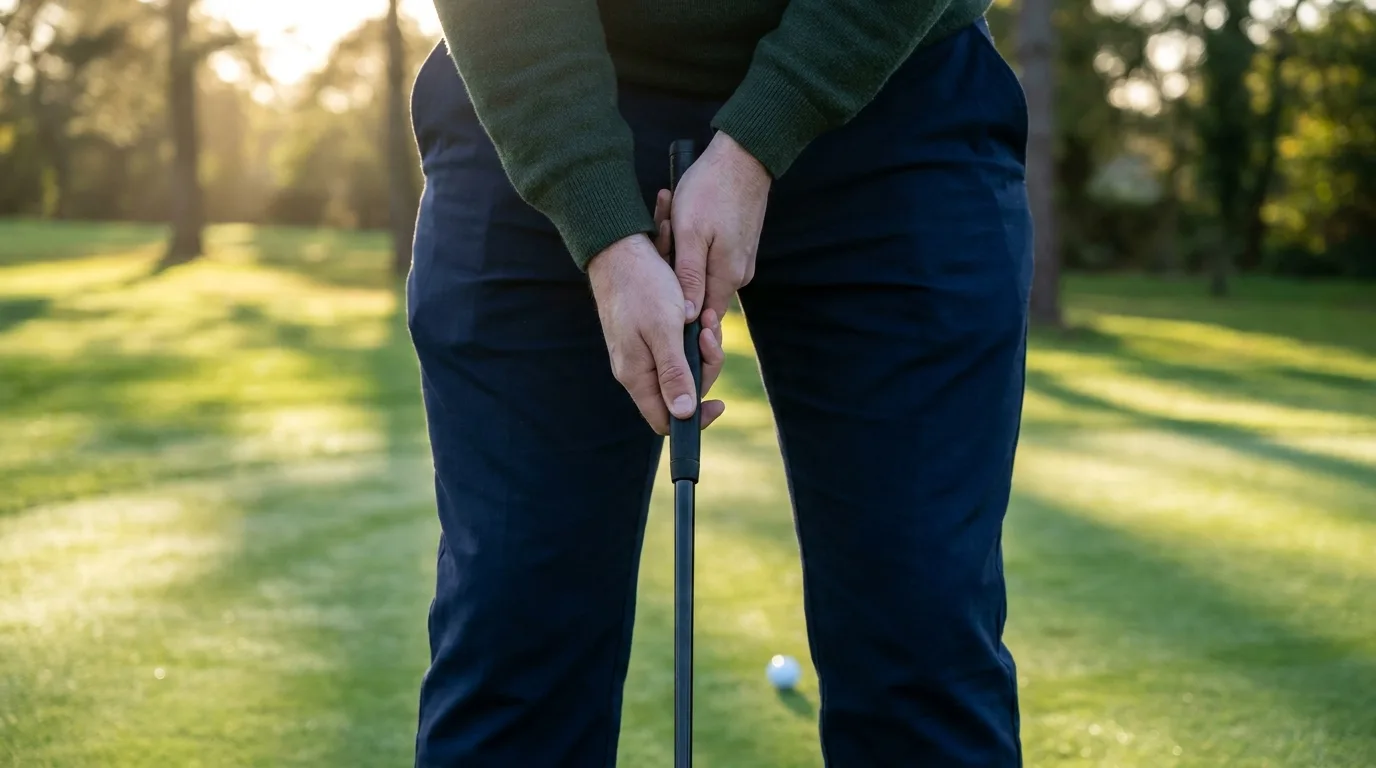
Why you keep missing short putts, and how to fix each cause

Nothing costs shots quite like a missed three-footer. The good news is that short putts usually go wrong for one of a handful of reasons, and each has a simple drill. Work out which one is yours and practise that.
1. The face is not square at impact
Sign: the ball starts left or right of where you aimed, even on a straight putt.
On a short putt, start line comes mostly from where the putter face points at impact. A face that is a degree or two open or closed is enough to miss.
Fix: the start-line gate. Two tees just wider than the ball, a foot in front of it. Hit 20 putts through the gate. You can find it in our alignment stick drills.
2. The wrists take over
Sign: the putter head overtakes your hands through impact, or misses go both ways.
Fix: join the arms to the putter so the shoulders do the work. Sticks running up the outside of your arms give you instant feedback when the wrists flick. Full guide: how to stop your wrists breaking down.
3. You decelerate
Sign: putts come up short, or the stroke feels jabby. Often caused by a backswing that is too long, so you slow down to compensate.
Fix: shorten the backswing and make the through-stroke at least as long. Practise with a smooth count: "one" back, "two" through.
4. You look up too early
Sign: contact feels thin or off the toe, and your shoulders open as you hit.
Fix: keep your eyes on the spot where the ball was until you hear it drop, or count to two after impact. On short putts there is nothing to see anyway.
5. Your aim is off
Sign: you make a good stroke and still miss on the same side.
Fix: lay an alignment stick pointing at the hole outside the ball and set up to it. Many golfers find they have been aiming a little off for years.
6. Too much break, not enough pace
Sign: you miss on the low side, with the ball dying away from the hole.
Fix: on short putts, play less break and hit it firmly enough to finish about a foot past if it missed. Use the clock drill: six balls around the hole at three feet, hole all six before moving back to four.
Find your cause, then practise that
Film ten short putts face on and look for the signs above. Most golfers have one main cause and one smaller one. Spend most of your practice time on the main one.
If yours is the face or the wrists, the quickest feedback comes from joining your arms to the putter. That is the job Pendulo was designed for: it clips to your putter below the grip and holds two alignment sticks up your arms, so a wrist flick is felt on the same stroke.
Keep reading
The pendulum putting stroke, explained simply and a 15-minute putting routine for home.

Practise the one-piece stroke with Pendulo
Clips to your putter below the grip and holds two alignment sticks up your arms, so you feel it the moment your wrists take over. 45 g, no tools.
Buy on Amazon UKQuestions golfers ask
What distance counts as a short putt?
Most golfers mean anything inside about six feet, the putts you expect to hole.
Should I hit short putts firmly?
Firm enough that the ball would finish a little past the hole if it missed. That takes much of the break and any small bumps out of play.
Why do I miss more short putts when I am nervous?
Nerves show up first in the small muscles of the hands and wrists. A stroke driven by the shoulders, with a steady routine, holds up better.